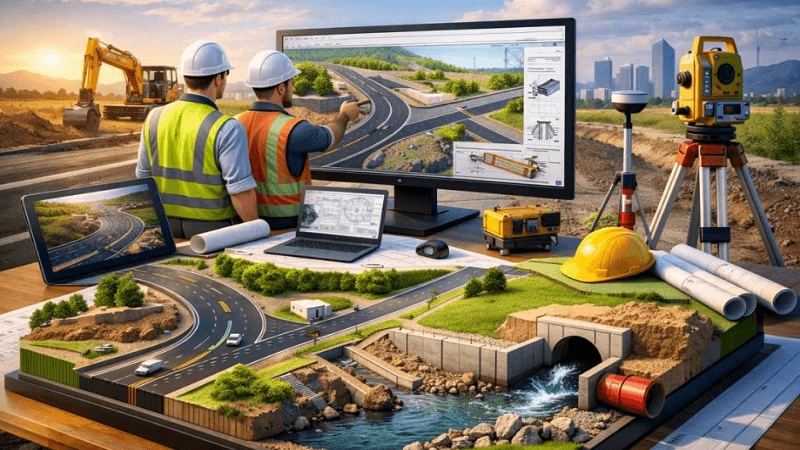
Why Is Accuracy Such a Big Challenge in Civil Infrastructure Projects?
Roads, drainage networks, and site developments form the backbone of modern infrastructure yet they are also some of the most error-prone project types in civil engineering.
Minor inaccuracies in levels, gradients, alignments, or coordination can quickly escalate into major on-site issues, leading to delays, redesigns, and costly rework. In the UK, where civil projects must meet strict planning, safety, and environmental standards, accuracy is not just desirable, it’s essential.
This is why Civil Drafting Services have become increasingly important for engineers, consultants, and contractors working on road, drainage, and site projects. Modern drafting approaches are helping firms significantly improve design precision, coordination, and construction confidence.
What Are Civil Drafting Services in Today’s Engineering Landscape?
Today’s Civil Drafting Services go far beyond basic drawing production. They support the full lifecycle of civil infrastructure projects using advanced CAD tools, intelligent workflows, and strict quality controls.
Typical civil drafting outputs include:
- Road layout plans and alignment drawings
- Drainage layouts and longitudinal sections
- Site grading, levels, and earthworks plans
- Utility coordination drawings
- Integration with Structural Drafting Services
Modern drafting combines 2D Drafting Services with 3D CAD Drawing Services, enabling engineers to visualise and validate designs before they reach the site.
How Do Civil Drafting Services Reduce Errors in Road Design?
Road projects demand absolute precision. Horizontal alignments, vertical profiles, cross-sections, and junction details all need to work together seamlessly.
Civil Drafting Services improve road design accuracy by:
- Ensuring consistent application of design standards (such as DMRB in the UK)
- Clearly defining centre lines, offsets, and carriageway widths
- Accurately representing superelevation, gradients, and sightlines
- Reducing misinterpretation during construction
With advanced CAD Drafting Services, engineers can quickly revise alignments while maintaining consistency across all related drawings, something that is extremely difficult with manual or outdated drafting methods.
According to data referenced by the UK Department for Transport, design clarity and early coordination play a critical role in reducing construction-stage risks on highway projects.
Why Are Drainage Projects Highly Dependent on Accurate Drafting?
Drainage design leaves little room for error. Incorrect invert levels, slopes, or pipe connections can cause flooding, non-compliance, and expensive remediation work.
Civil Drafting Services improve drainage accuracy by:
- Clearly defining invert levels and flow directions
- Coordinating drainage layouts with site grading
- Supporting sustainable drainage (SuDS) strategies
- Aligning drainage designs with structural elements
When combined with 3D CAD Drawing Services, drainage networks can be visualised in relation to roads, buildings, and utilities reducing clashes and improving constructability.
This is particularly relevant in the UK, where flood risk management and SuDS compliance are increasingly enforced by local authorities and environmental agencies.
How Do 3D CAD Drawing Services Improve Site Coordination?
Site projects often involve multiple disciplines working within tight spatial constraints. Roads, drainage, foundations, utilities, and landscaping all compete for space both above and below ground.
3D CAD Drawing Services enable civil engineers to:
- Visualise level differences and complex terrain
- Identify clashes between drainage, utilities, and structures
- Improve coordination with Structural Drafting Services
- Communicate design intent more clearly to contractors
Industry research published by McKinsey & Company shows that digital design coordination can reduce construction rework by up to 40%, making 3D drafting an increasingly valuable tool for site accuracy.
Why Is Integration with Structural Drafting Services So Important?
Civil and structural elements are closely linked especially in road crossings, retaining walls, culverts, and site developments.
Modern Structural Drafting Services, when coordinated with civil drafting, help:
- Align foundations with drainage and earthworks
- Ensure load paths and clearances are correctly represented
- Avoid conflicts between structural and civil elements
- Improve compliance with UK and Eurocode standards
Integrated drafting workflows reduce design silos, making project documentation more reliable and easier to interpret on site.
How Do 2D Drafting Services Still Play a Critical Role?
While 3D modelling continues to grow, 2D Drafting Services remain essential for civil engineering projects especially for approvals, construction, and maintenance documentation.
High-quality 2D drafting provides:
- Clear, standardised plans and sections
- Consistent annotations and dimensions
- Easier interpretation for site teams
- Faster approvals from local authorities
In the UK, many councils and regulatory bodies still require well-prepared 2D CAD drawings for planning and construction sign-off, making accurate 2D drafting a non-negotiable requirement.
What Role Do CAD Drafting Services Play in Meeting UK Standards?
Compliance is a major concern for civil engineers working in the UK. Drawings must align with British Standards, Eurocodes, and local authority guidelines.
Alt Text: CAD drafting services ensuring compliance with UK standards and regulations
Professional CAD Drafting Services help ensure:
- Standardised layering, line weights, and symbols
- Accurate representation of design intent
- Clear documentation for audits and approvals
- Consistency across large, multi-phase projects
Organisations such as NBS and the UK BIM Framework consistently emphasise the importance of standardised digital information in reducing risk across infrastructure projects.
How Do Civil Drafting Services Support Faster Project Delivery?
Accuracy and speed go hand in hand. Errors slow projects down, while clear, coordinated drawings accelerate construction.
By using modern Civil Drafting Services, firms benefit from:
- Faster revisions when design changes occur
- Reduced RFIs during construction
- Improved collaboration between stakeholders
- Fewer delays caused by drawing discrepancies
This efficiency is particularly valuable for infrastructure and land development projects operating under tight budgets and timelines.
Why Are UK Firms Investing More in High-Quality Civil Drafting?
Several industry-wide challenges are pushing firms to prioritise drafting accuracy:
- Growing infrastructure investment
- Increased regulatory scrutiny
- Skills shortages in engineering teams
- Pressure to reduce rework and waste
Modern CAD Drafting Services allow firms to maintain quality while adapting to these pressures without overburdening internal resources.
What Does the Future Look Like for Civil Drafting in Road and Drainage Projects?
The future of civil drafting is increasingly digital, data-driven, and collaborative.
Key trends include:
- Greater use of 3D and intelligent CAD tools
- Better integration between civil and structural data
- Increased focus on sustainability and resilience
- Adoption of standardised digital workflows
For road, drainage, and site projects, this evolution will continue to improve accuracy, safety, and long-term performance.
Conclusion
Accuracy is no longer just a technical requirement, it’s a strategic advantage.
By leveraging modern Civil Drafting Services, alongside Structural Drafting Services, 2D Drafting Services, 3D CAD Drawing Services, and professional CAD Drafting Services, civil engineering firms can significantly reduce errors, improve coordination, and deliver projects with greater confidence.
As infrastructure projects across the UK and globally become more complex, many organisations are turning to experienced CAD specialists including leading UK CAD design companies to support accurate, efficient, and compliant project delivery.
In road, drainage, and site development, precision isn’t optional. With the right drafting approach, it becomes achievable.
FAQs:
1. What are civil drafting services used for?
Civil drafting services are used to create accurate technical drawings for roads, drainage systems, site layouts, and infrastructure projects, ensuring clarity, compliance, and constructability.
2. How do civil drafting services improve accuracy in road projects?
They ensure precise alignments, levels, gradients, and cross-sections while maintaining consistency across all drawings, reducing on-site errors and construction rework.
3. Why is accurate drainage drafting important in the UK?
Accurate drainage drafting helps meet UK flood risk regulations, SuDS requirements, and environmental standards while preventing costly drainage failures and compliance issues.
4. What is the difference between 2D drafting services and 3D CAD drawing services?
2D drafting services provide clear plans and sections for approvals and construction, while 3D CAD drawing services offer visualisation, clash detection, and better coordination between disciplines.
5. Can civil drafting services reduce construction delays?
Yes. Clear, coordinated CAD drafting services minimise RFIs, design conflicts, and misinterpretations, helping projects stay on schedule and within budget.
6. How do civil and structural drafting services work together?
Civil and structural drafting services align foundations, drainage, and load-bearing elements to avoid clashes and ensure safe, compliant construction.
7. Are civil drafting services required for UK planning approvals?
Most UK planning authorities require professionally prepared CAD drawings that follow British Standards, making civil drafting services essential for approvals.
8. Do 3D CAD drawing services help with site coordination?
Yes. 3D CAD drawings allow engineers to visualise terrain, underground utilities, and structural elements together, improving coordination and reducing design conflicts.
9. Who typically uses civil drafting services?
Civil engineers, infrastructure consultants, contractors, developers, and local authorities commonly use civil drafting services for road, drainage, and site development projects.
10. Why are UK engineering firms increasingly outsourcing civil drafting services?
Outsourcing provides access to skilled CAD professionals, reduces internal workload, improves turnaround times, and ensures consistent drawing quality.